
T: +86-757-2339-5985
E: tp@topcod.com.cn
E: tp@topcod.com.cn
No.6, Pai Sha Industrial Road, Pai Sha Community, Longjiang Town, Shunde District, Foshan City, Guangdong Province, China.
Views: 0 Author: Site Editor Publish Time: 2026-10-16 Origin: Site


Have you ever opened a shipment of expensive electronics only to find the circuit boards ruined by microscopic rust? Or perhaps you unsealed a batch of premium beef jerky that turned moldy weeks before its expiration date. Moisture damage costs global supply chains millions every single year. It quietly destroys inventory while goods sit in transit or on warehouse shelves.
Guessing the right desiccant size is a massive engineering flaw. Procurement teams frequently eyeball the requirement. They either overspend on unnecessarily large pouches or undersize them. Undersizing leaves products entirely vulnerable to fluctuating humidity.
In this technical guide, we break down the exact sizing formulas and distribution strategies required to protect your goods. We will explore proper desiccant sizing from the ground up. You will learn fundamental volume calculations, strict industry-specific mandates, FDA compliance for consumables, and anti-static requirements for delicate tech hardware.
To accurately size a desiccant, you must understand its physical chemistry. Silica gel is an amorphous, highly porous form of silicon dioxide. Unlike a household sponge that absorbs water into its structural volume, these synthetic beads operate through adsorption. Water vapor molecules adhere to the vast internal surface area of the microscopic pores within the bead. This traps the humidity effectively without changing the physical shape of the material.
Sizing remains a critical variable because these beads have a finite capacity. Under standard conditions of 25 degrees Celsius and 80 percent relative humidity, high-quality silica can adsorb approximately 30 to 40 percent of its own weight in water. If a pouch is undersized for the container volume, it reaches maximum saturation prematurely. Once saturated, the absorption process halts entirely.
Recent supply chain analyses reveal a distinct industry shift toward highly optimized active packaging. As global logistics face increasingly unpredictable climate extremes, packaging engineers are abandoning outdated humidity control methods. Ocean freight conditions are harsher than ever, rendering guesswork obsolete.
Specifically, the trend is moving toward precisely calculated, data-driven silica gel moisture absorption sizing. Stricter export regulations across the European Union and North America now demand verifiable moisture control documentation for sensitive goods. Companies are leveraging smart sensors during transit to map humidity spikes, proving that arbitrary desiccant sizing fails under real-world stress. This data-first approach minimizes material waste while ensuring zero-defect arrival rates for sensitive electronics and perishable foods.
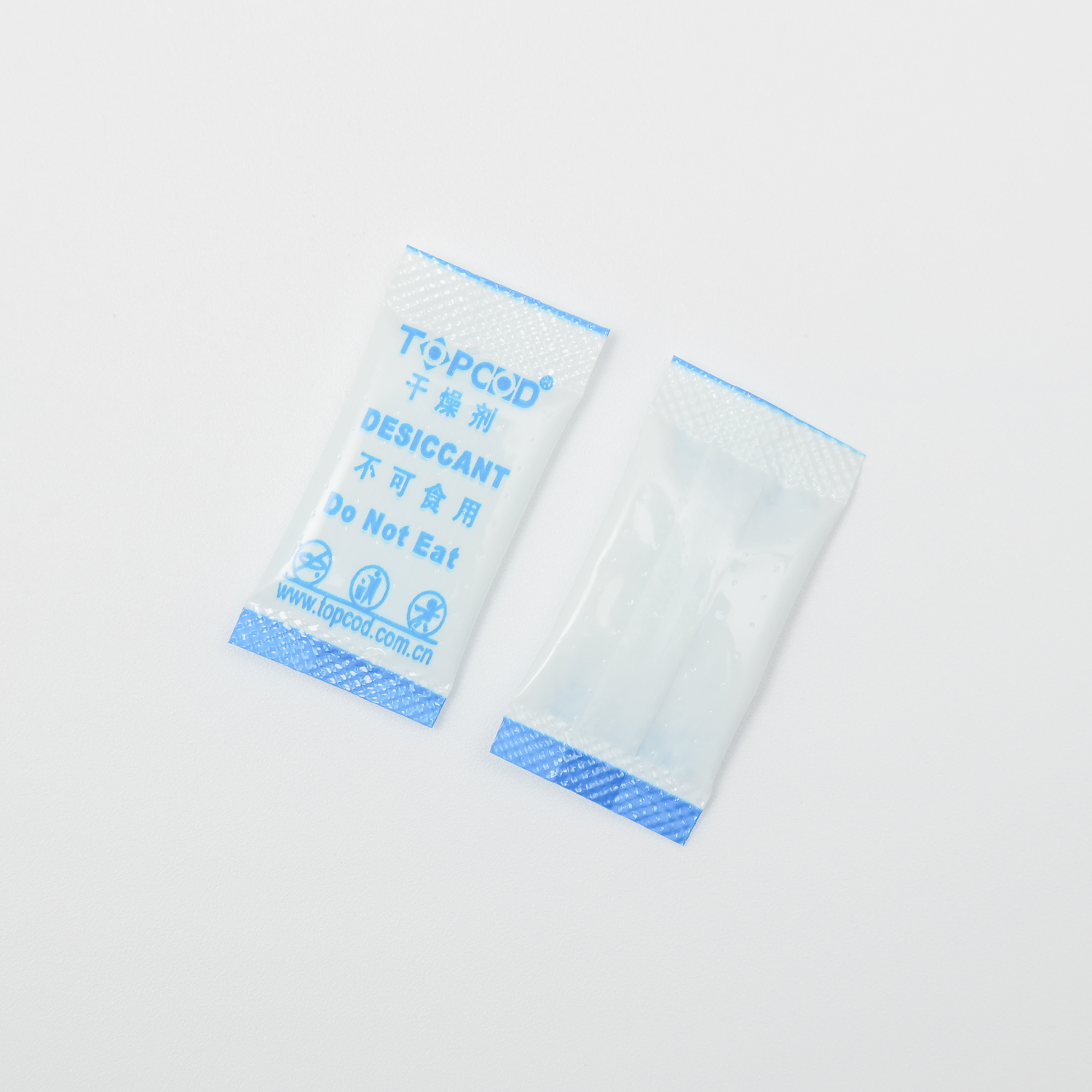
Accurate sizing relies on empirical volume calculations rather than estimation. The foundation begins with the standard volume formula utilized across the global packaging industry.
The universally accepted baseline is 1 gram of silica gel per 100 cubic inches of hermetically sealed volume. Alternatively, engineers calculate this as approximately 1.2 grams per cubic foot.
To determine the required baseline weight, follow this systematic calculation:
For example, a sealed box measuring 12 inches long, 10 inches wide, and 8 inches high yields a total volume of 960 cubic inches. Dividing 960 by 100 gives you 9.6 grams. In this scenario, you round up and insert a standard 10-gram sachet.
To streamline your procurement, refer to this baseline engineering chart mapping container volume to standard product specifications.
| Container Volume | Calculated Requirement | Recommended Topcod Size | Typical Application |
|---|---|---|---|
| Up to 50 cubic inches | 0.5 grams | 0.5g Pouch | Pill bottles, small spice jars |
| 50 - 100 cubic inches | 1.0 gram | 1g Pouch | Shoe boxes, small electronics |
| 101 - 200 cubic inches | 2.0 grams | 2g Pouch | Beef jerky bags, camera lenses |
| 201 - 500 cubic inches | 5.0 grams | 5g Pouch | Bulk supplements, small mechanical parts |
The baseline formula assumes a perfect, impermeable barrier. However, different outer packaging materials possess varying Moisture Vapor Transmission Rates. This metric measures how quickly humidity from the outside environment permeates through the packaging material over a 24-hour period.
High-barrier materials like metallized Mylar have a very low transmission rate, making the baseline formula highly accurate. In contrast, porous materials like corrugated cardboard allow continuous moisture ingress. When utilizing high-transmission materials, packaging engineers multiply the baseline desiccant weight by a factor of 1.5 to 2.0 to compensate for ongoing vapor penetration.
The electronics sector relies heavily on precise moisture control. Modern circuitry is exceptionally susceptible to microscopic environmental damage.
Even minute levels of condensation can severely compromise printed circuit boards. Imagine a sealed box sitting on a humid loading dock. As temperatures drop overnight, trapped air releases water onto cold metal components. When this moisture settles on a circuit board, it interacts with residual manufacturing salts to create an electrolytic solution. This microscopic puddle facilitates galvanic corrosion and promotes dendritic growth. Once tiny metal filaments bridge the gaps between solder pads, an irreversible short circuit occurs.
Hardware is often housed in anti-static bags. The sizing generally follows the standard baseline but must adjust for component density.
Standard desiccant packaging materials can generate triboelectric charges when rubbing against other surfaces in a highly dry environment. For sensitive integrated circuits, electrostatic discharge is just as fatal as water damage. Therefore, it is imperative to use desiccants packaged in specialized anti-static substrates. These safe materials dissipate static charges, ensuring the humidity control solution does not inadvertently fry the electronic components it protects.
When packaging edible goods, moisture control is not merely a matter of preserving product quality. It is a critical component of consumer safety and regulatory compliance. Excess water activity in food packaging accelerates lipid degradation, causes dry powders to cake, and creates an optimal environment for microbial proliferation.
It is a common misconception that all desiccants are identical. While the silicon dioxide beads inside are generally non-toxic, the food-grade classification depends entirely on the outer assembly. To be certified for direct contact with consumables, food grade silica gel packets must strictly adhere to FDA regulations, specifically under 21 CFR 176.170.
Furthermore, standard industrial sachets may use low-cost paper bound with chemical adhesives or printed with toxic inks that leach into your product. In contrast, food-safe variants utilize high-density spunbond polyethylene or specially coated, FDA-compliant paper. These premium materials are highly resistant to tearing, ensuring beads never spill into a bag of trail mix or spices.
Determining the correct size for edibles requires balancing the container volume, the inherent water activity of the food, and the expected shelf life.
Once you calculate the total required weight, a secondary logistical dilemma emerges. If a shipping carton requires 10 grams of protection, should you utilize a single 10-gram pouch or ten individual 1-gram pouches?
Distributing the required weight across multiple smaller units offers significant kinetic advantages. Adsorption is a surface-level phenomenon. Ten 1-gram pouches expose significantly more substrate surface area to the surrounding air than one 10-gram pouch. This allows the beads to pull humidity from the environment much more rapidly during the initial sealing phase.
Additionally, air circulation is severely restricted inside long boxes or containers packed tightly with compartmentalized components. A single large sachet placed at one end of the box creates a dry zone immediately around it, while the opposite end remains dangerously humid. Distributing small units throughout the container eliminates these localized micro-climates.
Despite the kinetic advantages of multiple small units, utilizing a single large pouch is often the preferred strategy for operational reasons. From a procurement standpoint, purchasing one large unit is generally more economical. Furthermore, on a high-speed automated assembly line, programming a machine to drop a single item into a box is significantly faster and less prone to error.
In the context of food packaging, safety is paramount. A single 5-gram sachet is highly visible to the consumer and easily identified as a non-edible insert. Placing five tiny 1-gram sachets inside a bag of dried fruit drastically increases the ingestion risk.
Even experienced packaging professionals make critical errors when implementing moisture control protocols. Misunderstanding the mechanics leads to compromised product integrity and severe financial losses.
Procurement departments often attempt to shave fractions of a cent off unit costs by downsizing the desiccant. This is a false economy. A pouch has strict physical limits. If a 10g requirement is met with a 5g pouch, it reaches maximum capacity within the first few weeks of a multi-month shelf life. Once saturated, the relative humidity inside the packaging spikes. Saving pennies on a smaller insert frequently results in thousands of dollars in ruined inventory.
A fundamental engineering principle of moisture control is that desiccants are only effective within a hermetically sealed environment. If a corrugated cardboard box has unsealed seams, the beads will continuously attempt to adsorb humidity from the external warehouse air. The material reaches maximum saturation within hours, long before the product ships. Packagers must ensure the primary container creates a distinct barrier against external vapor.
The efficacy of your moisture control strategy is directly tied to the quality control standards of your supplier. Sourcing from unverified, low-cost distributors introduces hidden variables that undermine your entire packaging protocol.
When evaluating manufacturers, prioritize objective quality metrics. Reputable suppliers provide accurate gram weights with minimal variance. A poorly manufactured pouch labeled as 5 grams might only contain 3.5 grams of active material. Commercial buyers must demand documentation, including ISO 9001 certifications, RoHS compliance, and FDA compliance certificates for consumable applications.
Accurate sizing relies on a straightforward mathematical formula of 1 gram per 100 cubic inches of volume. However, you must carefully adjust this baseline calculation for your specific product type, outer packaging material, and shipping duration.
Environmental factors heavily influence your final packaging decisions. Whether you are safeguarding delicate circuit boards from galvanic corrosion or protecting premium beef jerky from mold, investing in the correct desiccant size protects your valuable inventory from irreversible damage.
Think of it as a highly effective, low-cost insurance policy. Evaluate your current packaging setup today. Apply our engineering formulas to determine your exact requirement, and partner with a trusted manufacturer like Topcod to secure high-quality, compliant moisture control solutions.
Standard white silica gel is chemically inert and non-toxic, meaning it is not poisonous if accidentally touched or ingested in small quantities. However, it presents a choking hazard for small children and pets. Some industrial-grade variants contain color-changing moisture indicators that are toxic and require extreme care. For any consumable products, manufacturers must exclusively use certified food-grade materials.
Standard white beads do not change their physical appearance as they adsorb humidity. They will not swell, dissolve, or change color. The only definitive way to determine if a standard pouch has reached its maximum capacity is to weigh it. Because the material holds roughly 30 to 40 percent of its weight in water, a 10-gram pouch weighs between 13 and 14 grams when fully saturated.
For commercial packagers and manufacturers, reusing desiccants is highly discouraged. The commercial recharging process is imprecise. The substrate material itself can degrade, burn, or lose its structural integrity during heating. To guarantee consistent absorption rates and ensure strict product safety compliance, commercial entities must always use fresh, factory-sealed inventory.
When correctly sized and placed inside a hermetically sealed high-barrier container, these packets can maintain optimal humidity levels for 12 to 24 months. The exact lifespan depends entirely on the moisture vapor transmission rate of the outer packaging and the ambient storage temperature.
For electronics, using excess desiccant is rarely an issue and simply provides a larger safety buffer against moisture. However, for certain foods like soft baked goods, dried fruits, or leather products, using too large of a packet can strip essential moisture from the product itself, causing it to become overly brittle, stale, or cracked.


