
T: +86-757-2339-5985
E: tp@topcod.com.cn
E: tp@topcod.com.cn
No.6, Pai Sha Industrial Road, Pai Sha Community, Longjiang Town, Shunde District, Foshan City, Guangdong Province, China.
Views: 0 Author: Site Editor Publish Time: 2026-10-15 Origin: Site


You stand on a busy loading dock. You break the metal seal of a newly arrived shipping container. Instead of pristine electronics or premium textiles, a pungent, earthy smell of mildew hits you. The goods are covered in mold, rust, and soggy cardboard. Unfortunately, this catastrophic scenario plays out daily in global logistics.
Most supply chain professionals understand the basic need for moisture protection. Yet, many fail to account for two critical variables. What are they? The specific meteorological climate of the shipping route and the total transit duration. Relying on a standard, arbitrary amount of moisture absorbers for every shipment is a massive gamble. It frequently ends in rejected goods.
Implementing a strategic defense against internal condensation is essential. Industry insiders call this phenomenon container rain. Choosing the correct type of absorber and calculating the precise quantity depends entirely on the geographical path. It also depends on how many days the cargo spends at sea. In this comprehensive guide, you will learn how to optimize your moisture mitigation strategy. This ensures cargo integrity across any global voyage.
To fully grasp why route and time variables matter, logistics managers must first understand the environmental physics. What exactly happens inside a sealed steel box during a long ocean voyage? Moisture damage is rarely the result of a physical leak. Rather, it is a localized atmospheric phenomenon driven by the natural water cycle.
The primary threat to dry freight is container rain. This is a destructive cycle of evaporation and condensation. When a container is loaded at the origin facility, it traps the ambient air of that specific environment. Furthermore, many types of cargo contain inherent, microscopic water weight. Agricultural goods, textiles, and wooden pallets are prime examples.
As the sun beats down on the steel exterior during the day, internal temperatures can easily spike above 60 degrees Celsius. This intense heat causes the inherent moisture within the goods and pallets to evaporate. The trapped air absorbs this vapor, drastically increasing the internal absolute humidity. When night falls, the external temperature rapidly drops. The steel walls cool much faster than the internal air. Once the air temperature hits its dew point, it can no longer hold the evaporated water vapor. It condenses into heavy droplets on the ceiling. Eventually, this water rains down onto the goods below.
Interrupting this cycle requires active intervention. By deploying a high-quality cargo container desiccant, shippers can effectively trap excess humidity as it evaporates. This proactive absorption maintains a dry internal environment. It neutralizes the threat of condensation regardless of how violently the external temperatures shift.
The geographical path a vessel navigates plays a massive role in dictating moisture dynamics. Shippers must analyze the historical meteorological conditions of their specific routes. This data is crucial to deploy an effective defense strategy.
Recent global logistics analyses reveal a troubling trend. Extreme weather events and shifting climate norms have made historical route data less predictable. In addition, geopolitical tensions have forced many shipping lines to reroute vessels around longer, alternative paths. A journey that once took 30 days might now take 45 days, exposing cargo to prolonged humidity and unexpected climate zones. Logistics experts now recommend a highly conservative approach. Over-preparing for climate volatility is no longer an option; it is a standard best practice in modern freight management.
Ocean freight routes crossing the equator represent the highest risk category for atmospheric volatility. Imagine a vessel departing from a freezing winter climate in Northern Europe. It sails directly into the sweltering heat of a tropical equatorial zone. The metal shipping container experiences extreme thermal shock. The cold air trapped inside expands rapidly, interacting with the heating steel.
Conversely, moving from a humid tropical origin into a freezing destination causes immediate and massive condensation. The dense, wet air hits freezing steel walls. These rapid, severe temperature swings force massive amounts of condensation to form almost instantly. In these volatile environments, standard baseline calculations fall dangerously short. Shippers must utilize maximum absorption capacity. Often, this means doubling standard quantities to handle sudden atmospheric spikes without reaching premature saturation.
Not all routes demand the same level of aggressive protection. A voyage from Southeast Asia to Western Europe involves loading cargo in a high-humidity environment. The air trapped inside on day one is already thick with moisture. In contrast, a purely temperate route experiences milder temperature shifts. Shipping metal automotive parts from Canada to the UK during autumn involves significantly lower ambient humidity.
Specifically, routes originating in or passing through consistently high-humidity zones should utilize 30 to 50 percent more absorbent material than temperate routes. Adjusting your baseline based on the specific climate profile is the only way to guarantee cargo safety.
While geography dictates the intensity of the moisture, transit time dictates the duration of the exposure. In the realm of cargo protection, time is the ultimate enemy of dry goods.
A brief, 10-day short-haul voyage generally requires only basic protection. The day and night temperature cycles only occur ten times. Therefore, the total volume of water evaporated and condensed remains relatively low. However, a 45-day trans-oceanic journey presents a completely different logistical hurdle.
This brings up the critical concept of saturation. Absorbents have a strict chemical limit. Once the material reaches its maximum absorption capacity, it ceases to function entirely. For long-haul trips, shippers must use advanced materials capable of drawing water vapor from the air continuously for weeks. If the absorbent saturates on day 30 of a 45-day voyage, the cargo sits completely unprotected in a humid incubator for the final two weeks.
A common and costly logistical oversight is equating transit time strictly with days at sea. In reality, effective shipping moisture control calculations must account for the entire lifecycle of the sealed container.
Global supply chain congestion remains a persistent issue. Vessels frequently idle at anchor outside congested ports for weeks. Containers sit on sun-baked asphalt in humid coastal terminals awaiting customs clearance. During these stationary periods, the container rain cycle actually accelerates. There are no ocean breezes to cool the steel. Consequently, risk managers strongly advise adding a safety buffer of 10 to 15 days to total transit time calculations. This buffer accounts for inevitable modern supply chain delays.
Selecting the correct chemical composition for your moisture defense is just as important as calculating the quantity. Commercial options vary wildly in their performance metrics. Choosing the wrong material can doom a shipment before it even leaves the port.
For international ocean freight, calcium chloride is widely regarded as the gold standard. Its chemical advantage lies in its aggressive hygroscopic nature. It actively and rapidly attracts water molecules from the surrounding air. High-quality formulations can absorb up to 300 percent of their own weight.
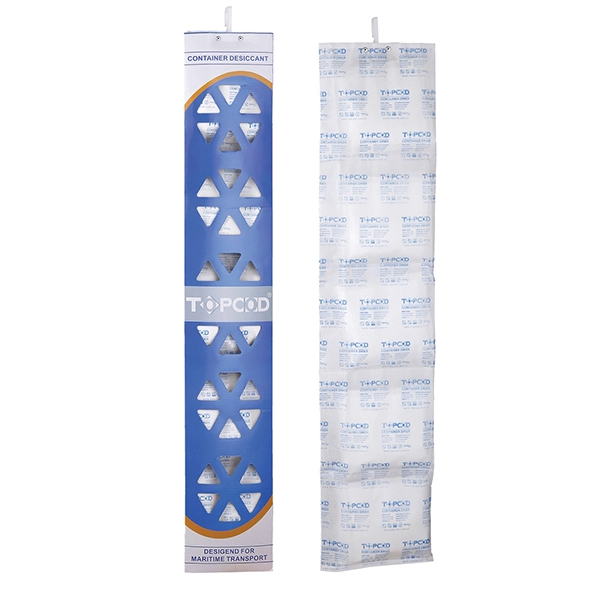
Furthermore, advanced packaging technology ensures this captured water does not leak back out. When you utilize a premium calcium chloride dry bag, the active chemical reacts with the vapor. It transforms the moisture into a thick, leak-proof gel. This gel is securely contained within a one-way breathable membrane, such as Tyvek or specialized PET film. For instance, a 1kg container desiccant strip with a robust hanging hook can continuously protect a 20-foot container for over 60 days. This makes it the non-negotiable choice for long transit times, high-fluctuation route climates, and sensitive agricultural goods.
Silica gel is a fantastic, cost-effective product for small consumer packaging. It works perfectly for shoeboxes, leather bags, or pharmaceutical bottles. However, it is fundamentally unsuited for large-scale ocean freight.
Silica gel typically only absorbs about 25 to 30 percent of its own weight. In the context of a 40-foot shipping container experiencing severe temperature swings, silica gel will reach maximum saturation within the first few days. Once full, it becomes useless dead weight. To achieve the same protective capacity as a few kilograms of calcium chloride, a shipper would need to pack the container with an impractically large and expensive volume of silica gel.
| Feature | Calcium Chloride Solutions | Traditional Silica Gel |
|---|---|---|
| Absorption Capacity | 200% to 300% of its own weight | 25% to 30% of its own weight |
| Effective Duration | 60 to 90+ days | 7 to 15 days in high humidity |
| Post-Absorption State | Turns into a leak-proof solid gel | Remains a bead, risk of desorption at high heat |
| Ideal Application | Ocean freight, long-haul transit, agricultural goods | Small enclosed consumer packaging |
Moving from theory to practice, relying on guesswork for cargo protection often leads to catastrophic financial loss. Shippers must employ a systematic, mathematical approach to determine their exact purchasing needs.
To calculate the required weight of your moisture absorbers, you must evaluate three specific variables:
Instead of abstract formulas, here is a practical baseline you can directly apply to your operations. Imagine you are shipping a 40-foot container packed with moisture-rich agricultural goods from a humid port in Southeast Asia to North America. The journey is scheduled for 45 days.
For this specific scenario, you will typically need between 10 kg and 14 kg of high-capacity calcium chloride. Distribute this evenly throughout the space to maintain a safe internal atmosphere.
Even the most accurate calculations and premium products will fail if the warehouse loading team installs them incorrectly. Proper placement is essential for the chemical to interface efficiently with the air.
Container rain forms on the ceiling where the cold steel meets the rising warm air. Therefore, moisture absorbers must be positioned as high as possible. Warehouse workers should utilize the built-in lashing rings located near the top of the container walls. Hanging 1kg desiccant poles from these rings is highly effective.
It is absolutely critical that the loading team does not crush or cover the bags with boxes. The active ingredients require continuous, open airflow to pull humidity from the environment. If a bag is wedged tightly between two shrink-wrapped pallets with no exposed surface area, it cannot breathe. This renders it completely useless.
Before the first pallet is ever loaded, the container itself must be rigorously inspected. Step inside the empty container, close the doors, and look for pinholes of daylight. This is a vital practical step. Any structural holes will allow endless ocean humidity to enter, rapidly exhausting your moisture defenses.
In addition, check the rubber gaskets around the doors to ensure they are intact. Finally, it is standard industry practice to tape the small ventilation slots shut. If left open, the absorbent material will continuously try to dehumidify the entire ocean, saturating in record time. Taping the vents allows the chemicals to focus solely on treating the trapped air inside the box.
Ultimately, supply chain optimization revolves around risk management and return on investment. Treating moisture control as an afterthought or a place to cut pennies is a massive financial misstep.
Consider the stark economics of international shipping. A standard 40-foot container loaded with consumer electronics, designer textiles, or specialty agricultural products holds immense value. It can easily range from 50,000 to over 250,000 dollars.
If that container arrives at its destination with severe mold or rusted metallic components, the receiver will likely reject the entire shipment. The shipper is then left holding the bag. They face the loss of goods, expensive disposal fees, wasted freight costs, and incalculable reputational damage with their client.
In contrast, outfitting that same 40-foot container with premium, route-optimized calcium chloride typically costs between 30 and 80 dollars. This represents a minuscule fraction of a percent of the total cargo value. Optimizing this process based on route climate and transit time is not merely a packaging expense. It is a highly effective, low-cost insurance policy for your global operations.
Route climate and transit time are the undisputed dictators of moisture risk in global logistics. Extreme temperature swings create severe condensation threats. Longer voyages expose goods to prolonged humidity, pushing protective materials to their limits. Failing to account for these variables often results in premature saturation and ruined cargo.
Using the right tools, specifically high-capacity calcium chloride solutions, prevents costly cargo damage effectively and reliably. Shippers must evaluate their specific geographical routes. They must calculate expected transit times with built-in buffers for delays. Finally, they must apply the correct volume of absorbents for every unique voyage.
Take the time to evaluate your current shipping routes before your next major loading schedule. Do not leave your high-value cargo to chance. Ready to upgrade your moisture defense? Visit Topcod today to explore our premium range of container desiccants and calcium chloride dry bags. Our packaging experts can provide a tailored, data-driven calculation to protect your supply chain profitability.
The lifespan depends heavily on the specific chemical composition and the route's climate volatility. A high-quality calcium chloride product can actively absorb moisture for 45 to 90 days before reaching full saturation. This makes it the ideal solution for extended international transit times and unpredictable port delays.
Yes. Loading cargo in high-humidity conditions traps a significantly higher volume of ambient moisture inside the container from the very beginning of the journey. Logistics experts recommend increasing your moisture mitigation measures by 20 to 30 percent during wet seasons. This compensates for the initial heavy moisture load.
Yes, provided you use premium products. High-quality bags are engineered with specialized leak-proof, unidirectional membranes. These membranes allow moisture vapor to enter but chemically transform the absorbed liquid into a thick, solid gel. This completely prevents any toxic leaks, drips, or spills onto sensitive food or agricultural products.
The materials do not mechanically fail, but they can reach their maximum saturation point if a delay extends the transit time beyond the originally calculated capacity. Once full, they stop absorbing. This is exactly why it is crucial to calculate your needs with a 10 to 15-day buffer. This accounts for unexpected port congestion or customs holds.
Container desiccants are specially formulated for large, high-humidity environments and massive temperature fluctuations. They typically use calcium chloride, which absorbs up to 300 percent of its weight and turns into a gel. Regular silica gel packets are designed for small, sealed consumer boxes and only absorb about 30 percent of their weight, making them ineffective for ocean freight.
Most premium calcium chloride desiccants are non-toxic and environmentally friendly. Once the journey is complete and the material has turned into a solid gel, they can generally be disposed of as regular commercial waste. However, always check your local waste management regulations and the manufacturer's specific safety data sheet to ensure compliance.


