
T: +86-757-2339-5985
E: tp@topcod.com.cn
E: tp@topcod.com.cn
No.6, Pai Sha Industrial Road, Pai Sha Community, Longjiang Town, Shunde District, Foshan City, Guangdong Province, China.
Views: 0 Author: Site Editor Publish Time: 2026-06-25 Origin: Site


Inadequate moisture control creates devastating financial consequences for global supply chains. You might see container rain ruining logistics shipments. You might find short-circuited electronics or degraded 3D printing filaments upon delivery. These structural failures severely impact your bottom line. While many materials prevent moisture damage, choosing the wrong chemical profile introduces massive risks. You could contaminate a delicate product. You could waste your entire packaging budget on the wrong solution.
Decision-makers often face a bottleneck when evaluating different options. They need exact data, not marketing fluff. Both options protect against humidity, but they perform drastically different actions behind the scenes. Misunderstanding these actions leads to severe procurement mistakes.
This guide breaks down the physical properties, absorption limits, and risk profiles of top moisture absorbers. We will help your procurement and operations teams make an evidence-based choice. You will learn exactly how these materials perform under stress. We also outline common hidden costs so you can avoid costly specification errors in the future.
Capacity vs. Precision: Calcium chloride absorbs up to 300% of its weight but turns into a gel/liquid; a silica gel desiccant absorbs roughly 30-40% but maintains a dry physical state.
Best Use Cases: Use calcium chloride for high-humidity, bulk-volume environments (ocean freight, agriculture). Use silica gel beads for enclosed, highly sensitive micro-environments (electronics, pharmaceuticals, 3D printing).
Risk Factor: Calcium chloride carries a structural leakage risk if punctured; silica gel offers higher stability and food/pharma compliance safety.
A silica gel desiccant works through physical adsorption. The beads feature millions of microscopic pores. These pores trap moisture molecules internally. The material does not change its physical form. It remains entirely dry to the touch even when fully saturated. You never have to worry about the beads dissolving. They retain their solid spherical shape at all times.
This mechanism relies strictly on physical trapping rather than chemical reactions. The material is chemically inert. It does not emit harmful gases or react with surrounding products. This non-toxic nature makes it incredibly safe. Industries use it as the absolute standard for FDA-compliant packaging. Cleanroom environments rely heavily on it. It perfectly protects delicate items without introducing chemical risks. Best practice dictates using these dry packets in highly sealed environments. Common mistakes include leaving the container slightly open, which rapidly exhausts the bead capacity.
A calcium chloride desiccant operates quite differently. It uses a process called chemical deliquescence. The salt actively binds with moisture from the air. This triggers a permanent chemical reaction. The material transitions from a dry powder into a heavy liquid or viscous gel. It fundamentally alters its physical state.
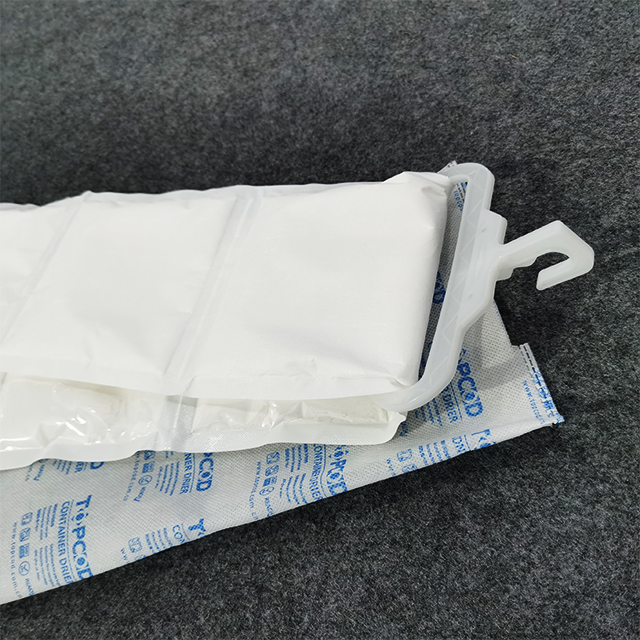
Because it turns into a brine, it requires specialized packaging. You cannot put it in simple paper packets. Manufacturers must use leak-proof, highly engineered materials like Tyvek. This semi-permeable membrane allows water vapor to enter. However, it blocks the resulting liquid from escaping. If you use this chemical, you must trust the packaging integrity entirely. A common mistake involves squeezing or crushing the pouches during loading. This physical stress can breach the membrane and ruin the protection.
You need hard data to make correct purchasing decisions. The most obvious difference lies in raw capacity. Calcium chloride absorbs over ten times more moisture by weight. A standard dry bead packet usually stops at 30% to 40% of its own weight. In contrast, the chemical salt can absorb 300% or more.
Their absorption curves also differ greatly. Dry beads pull moisture rapidly. They work incredibly fast in small, tightly enclosed spaces. They quickly drop the relative humidity to zero. The chemical salt takes longer to hit peak performance. It excels over extended durations. It actively thrives during massive high-humidity spikes. You must evaluate your time horizon before choosing between them.
Environmental temperature dramatically impacts performance. Silica functions optimally at standard room temperatures. It efficiently protects goods stored in climate-controlled warehouses. However, its efficiency drops sharply once temperatures exceed 100°F (38°C). At extreme heat, it can even release captured moisture back into the air. You must account for this limitation.
Calcium chloride operates aggressively across severe temperature fluctuations. It remains highly effective even above 140°F. This robust thermal tolerance makes it perfect for global shipping routes. It easily handles the violent temperature swings found in heavy ocean freight.
Liquid damage remains a top concern for supply chains. Solid beads offer exceptional environmental stability. The structure remains sound regardless of saturation. If a packet accidentally tears, you only face a minor clean-up of dry spheres. They will not stain or corrode your products.
The chemical salt introduces a severe "brine leak" risk. It transforms into a highly corrosive liquid. If a forklift punctures a pallet, the compromised packaging will leak acidic brine. This liquid instantly destroys metal components, agricultural goods, and electronics. You must weigh this risk heavily during your risk assessment.
Performance Metric | Silica Gel | Calcium Chloride |
|---|---|---|
Maximum Absorption Capacity | ~30% to 40% by weight | Up to 300%+ by weight |
Absorption Speed | Extremely fast in small enclosures | Steady and prolonged over weeks |
High Temperature Limits | Efficiency declines above 100°F (38°C) | Remains aggressive in extreme heat |
Structural Leakage Risk | Zero (remains a dry solid) | High (transforms into liquid brine) |
Different industries demand specific protective profiles. You should specify silica gel beads when precision matters most. Consider these exact use cases:
Electronics & Optics: Manufacturers demand absolute safety. They cannot tolerate any corrosive liquid leaks near microchips or lenses. A dry solution guarantees delicate circuitry remains spotless.
Pharmaceuticals & Food: Tightly regulated environments require chemically inert, non-toxic packaging. These dry beads pass stringent FDA compliance tests effortlessly.
Advanced Prosumer Uses: 3D printing enthusiasts use them for filament drying. Expensive extrusion nozzles clog easily if contaminated. Users prioritize clean handling and reusability via simple oven regeneration.
Heavy industries deal with massive moisture loads. You should specify the chemical salt alternative for macro-environments. Review these common bulk-volume scenarios:
Ocean Freight & Container Shipping: Container shipping creates a phenomenon called "container rain." Warm days and cold nights cause condensation to drip from the ceiling. A 40-day transit time across varying climate zones requires immense absorption power. Only a high-capacity chemical solution prevents structural rust on shipping containers.
Bulk Agriculture & Timber: Fresh crops and wood naturally release massive amounts of water vapor. This off-gassing overwhelms standard absorbents. You must deploy materials that strip huge volumes of water from the air continuously.
Procurement teams often misunderstand material scaling. Over-specification drains budgets rapidly. If you insist on using dry beads for a 40-foot shipping container, you face a logistical nightmare. You would need an economically unviable volume of packets.
The physical space required for thousands of packets eliminates valuable cargo room. You pay higher upfront material costs for no added benefit. Matching the exact chemical profile to the enclosure size prevents this budget waste.
Disposal workflows vary wildly between these two options. You must consider the end-of-life handling. Saturated chemical salt often requires specialized waste protocols. The resulting brine can disrupt local water systems if dumped improperly. Many municipal facilities refuse to accept it in standard dumpsters.
Your receivers might incur high disposal fees upon delivery. In contrast, standard municipal disposal easily handles exhausted dry bead packets. They pose no environmental threat to standard landfills. Additionally, many operations simply regenerate the dry beads in commercial ovens. This simple regeneration drastically reduces ongoing purchasing requirements.
A chemical absorbent relies entirely on its external packaging. We strongly warn against using cheap suppliers. A chemical pouch functions only as well as its semi-permeable membrane. Discount brands often use flimsy plastic or weak non-woven fabrics.
If a sharp edge or shifting cargo punctures the pouch, the results are catastrophic. The acidic gel will spill outward. A single puncture leads to severe asset damage. Quality control matters immensely when liquid formation is involved. You must verify membrane strength before finalizing any bulk purchase.
Procurement requires clear logic. Use this definitive desiccant comparison guide to finalize your shortlist. Follow these four actionable steps to protect your inventory properly.
Step 1: Assess the Environment Volume. Measure your packaging space. Choose micro-packaging like dry beads for small shoe boxes or pill bottles. Choose macro-transit chemicals for large shipping containers.
Step 2: Define the Tolerance for Liquid. Evaluate your product's sensitivity. If you have zero tolerance for leaks, default to solid dry beads. Protect electronics, leather, and optics from any liquid risk.
Step 3: Calculate the Duration. Map out your transit timeline. A short shelf-life domestic shipment needs fast, immediate drying. A 60-day ocean export demands a slow, high-capacity chemical reaction.
Step 4: Compliance Check. Review your industry regulations. Does your application require direct food contact? Do you need pharmaceutical drug approvals? Always select inert, FDA-compliant dry beads for human consumables.
You must match the chemical profile directly to your operational reality. Calcium chloride remains the undisputed champion for raw volume. It easily handles aggressive ocean transit and massive agricultural off-gassing. However, silica stands as the global standard for precision. It provides unparalleled safety for micro-environments, electronics, and human consumables. You cannot risk liquid contamination on expensive components.
We encourage you to calculate your specific moisture protection needs carefully. Review your shipping durations, temperature fluctuations, and compliance requirements. You can reach out to our engineering team for a custom packaging audit. Request a physical sample to test within your own workflow. Protecting your assets requires proactive, data-driven decisions. Do not let uncontrolled moisture destroy your bottom line.
A: You should always use dry silica beads for 3D printer filaments. They pose absolutely zero risk of corrosive liquid spilling onto your expensive filament rolls or extruder nozzles. Additionally, they offer immense reusability. You can easily bake saturated beads in an oven to dry them out. This makes them highly economical for prosumer applications.
A: No, you cannot reuse it. Once it undergoes chemical deliquescence and turns into a gel or heavy liquid, the structural change is permanent. You cannot bake the moisture out. In contrast, standard dry beads release their trapped moisture when exposed to sustained heat. This allows for repeated regeneration cycles.
A: Per gram, the chemical salt is generally cheaper. It also requires significantly less physical material to absorb the same amount of water vapor. This exceptional absorption ratio makes it highly cost-effective for large-scale logistics and global ocean freight. However, you must factor in potential hazardous disposal fees at the destination.


