
T: +86-757-2339-5985
E: tp@topcod.com.cn
E: tp@topcod.com.cn
No.6, Pai Sha Industrial Road, Pai Sha Community, Longjiang Town, Shunde District, Foshan City, Guangdong Province, China.
Views: 0 Author: Site Editor Publish Time: 2026-09-28 Origin: Site


The electronics manufacturing sector's transition to environmentally compliant, halogen-free components has fundamentally altered packaging and preservation requirements. Eliminating halogens and heavy metals meets stringent environmental and fire-safety compliance standards, specifically preventing the release of toxic, corrosive gases during thermal events. However, the alternative chemical formulations used in these indicator cards are highly sensitive to ambient conditions. Improper storage prior to deployment leads to premature color shifts, false positives, and compromised quality assurance data.
To ensure accurate humidity monitoring for electronics, quality control and supply chain teams must implement strict, verifiable storage and handling protocols for unused indicator cards. Relying on outdated storage methods designed for legacy materials ruins inventory and causes compliance failures. This guide details the technical storage parameters, handling risks, and facility requirements necessary to maintain indicator efficacy from the moment of receipt to final deployment on the production floor.
Strict Climate Control is Non-Negotiable: Unsealed halogen-free cards require storage environments with tightly controlled relative humidity (typically <60% RH) and stable temperatures to prevent premature chemical degradation.
Original Packaging Integrity Dictates Shelf Life: A halogen free humidity indicator card relies entirely on its factory-sealed Moisture Barrier Bag (MBB) and internal desiccants; compromised seals drastically reduce viability.
Handling Protocols Impact Accuracy: Micro-contaminants from bare hands (oils, salts) or airborne industrial particulates can permanently alter the porous substrate of cobalt free halogen free HICs, necessitating strict clean-handling procedures.
Proactive QA Prevents Downstream Failures: Establishing clear criteria for inspecting, resealing, and auditing stored HICs prevents defective cards from being packed with high-value electronic components.
Defining a functional indicator card at the point of use requires observing distinct color contrast and accurate relative humidity threshold indication. Legacy storage methods fail newer formulations because the underlying chemistry has completely changed. Traditional indicators relied heavily on cobalt-chloride and halogen-based compounds. These materials remained highly stable under varying storage conditions but posed severe environmental and health risks. The industry shift toward copper-based or organic-dye alternatives addresses these risks directly.
Removing halogens aligns with strict PVC-free mandates across global manufacturing sectors. It prevents the emission of toxic, corrosive gases during electrical fires, protecting personnel and sensitive networking gear. Extracting these stabilizing halogens fundamentally alters the hygroscopic nature of the indicating spots. The new chemical formulations react aggressively to their surrounding environment. They absorb moisture at a significantly accelerated rate compared to their legacy counterparts.
This heightened vulnerability to ambient moisture creates a narrow operational window. When exposed to standard factory-floor humidity, a Halogen Free Humidity Indicator Card begins reacting almost immediately. The time between opening the bulk packaging and inserting the card into a dry pack alongside electronic components must be strictly minimized. Prolonged exposure during this transfer phase leads to premature color shifts, rendering the card useless before it enters the shipping container.
Beyond moisture absorption, modern substrates face severe chemical contamination risks. Manufacturing environments frequently contain airborne sulfur, ammonia, and various volatile organic compounds (VOCs). These airborne contaminants interact aggressively with halogen-free dyes. Exposure to VOCs or sulfur triggers irreversible chemical reactions within the indicator spots. This results in false color readings that do not accurately reflect the moisture content of the package, destroying the reliability of the entire quality assurance process.
Contamination and degradation typically occur through a specific sequence of floor-level failures:
Operators open a bulk moisture barrier bag outside of a controlled dry-staging area.
Ambient factory humidity immediately begins penetrating the porous paper substrate of the top-layer cards.
Airborne sulfur from nearby wave soldering machines settles onto the exposed indicator spots.
The organic dye reacts with the sulfur, causing a permanent, blotchy color shift that mimics a high-humidity reading.
The compromised card is placed into a dry pack, where it fails to revert to its dry color, triggering a false failure during downstream receiving inspections.
Preserving indicator accuracy requires mapping specific environmental controls directly to the chemical vulnerabilities of the cards. Facility managers must establish strict baseline parameters for any area where these components are held prior to use. You cannot store these sensitive chemical tools on an open warehouse rack and expect them to function accurately months later.
Temperature thresholds play a direct role in long-term preservation. Industry-standard guidelines dictate maintaining storage environments between 20°C and 25°C (68°F to 77°F). Deviating from this narrow band introduces severe risks, particularly concerning thermal cycling. Rapid fluctuations in ambient temperature cause the air inside the factory-sealed bags to expand and contract. This cycling draws micro-amounts of ambient moisture through microscopic imperfections in the packaging. Sudden temperature drops cause internal condensation, where trapped moisture vapor turns into liquid water directly on the card substrate, instantly ruining the batch.
Relative humidity limits are equally unforgiving. The maximum ambient relative humidity for the storage facility must not exceed 60%. Storing sealed bags in environments exceeding 60% RH accelerates the moisture vapor transmission rate (MVTR) through the packaging materials over time. Even high-grade moisture barrier bags have a measurable MVTR. Continuous exposure to high external humidity forces moisture through the barrier at a faster rate, depleting the internal desiccant prematurely and initiating color shifts in the stored cards.
Light and UV degradation represent another unique challenge for halogen-free formulations. Many organic dyes used as alternatives to heavy metals exhibit high photolytic sensitivity. Prolonged exposure to direct sunlight or intense fluorescent factory lighting causes the indicator spots to fade. This UV-induced fading reduces the visual contrast of the spots, making them difficult or impossible to read accurately during downstream inspections. Facilities must implement dark storage protocols, utilizing opaque bins or dedicated, light-proof cabinets to protect inventory.
Storage Parameter | Legacy Indicators (Cobalt/Halogen) | Halogen-Free Indicators | Operational Impact |
|---|---|---|---|
Temperature Range | 15°C to 30°C | 20°C to 25°C | Strict thermal control prevents internal condensation and chemical degradation. |
Ambient RH Limit | Up to 70% RH | Strictly <60% RH | Prevents accelerated Moisture Vapor Transmission Rate (MVTR) through sealed bags. |
UV Sensitivity | Low to Moderate | High (Photolytic Degradation) | Requires opaque storage bins or dark cabinets to prevent dye fading. |
Chemical Vulnerability | Resistant to most VOCs | Highly reactive to Sulfur/Ammonia | Must be stored away from active soldering lines or chemical staging areas. |
Substrate Porosity | Standard | Highly Porous | Requires immediate transfer to dry environments upon opening to prevent rapid saturation. |
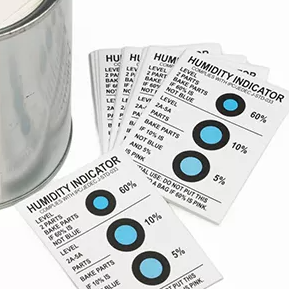
The operational reality of electronics packaging requires using partial tins or bags of indicator cards. Protecting the remainder of the batch demands rigorous procedural oversight. The integrity of the original packaging dictates the survival of the unused cards. A single breach in handling protocol destroys an entire tin of indicators.
Maintaining Moisture Barrier Bag (MBB) integrity begins at the receiving dock. Facilities must specify JEDEC-compliant bags from their suppliers. Upon vendor delivery, receiving personnel must inspect every seal. Punctures, weak seams, or compromised vacuum seals mean the internal environment has equalized with the outside atmosphere. Flag any compromised bag immediately. The cards inside have already begun absorbing moisture.
Desiccant management for partial packages is a frequent failure point on the production floor. When a bag is opened to retrieve a partial batch, the remaining cards must be resealed immediately. Operators must follow a strict sequence to ensure the remaining inventory survives:
Remove only the exact number of cards required for the immediate packaging run.
Calculate the required volume of fresh desiccant based on the remaining void space in the MBB.
Insert high-purity, non-corrosive desiccant (such as electronics-grade bentonite clay) into the bag.
Purge excess ambient air from the bag using a vacuum sealer.
Apply a wide, continuous heat seal across the opening, ensuring no wrinkles compromise the barrier.
Using incompatible desiccant types is a critical error. Low-grade desiccants off-gas trace chemicals or release microscopic dust particles that react with the halogen-free dyes. Only high-purity desiccants approved for electronics packaging should be used during the resealing process.
Clean-room handling standards are absolute. Operators must never touch a cobalt free halogen free HIC with bare hands. Human skin naturally secretes oils, sodium chloride (sweat), and amino acids. When these micro-contaminants transfer to the porous paper substrate of the card, they create localized hydrophobic or hydrophilic zones. A hydrophobic fingerprint prevents ambient moisture from reaching the indicator dye, causing a false negative. Salts draw excess moisture to a specific spot, causing a false positive. Mandating the use of powder-free nitrile gloves or clean-room finger cots is the only way to prevent this permanent handling damage.
Procurement teams face a difficult trade-off between bulk purchasing for lower unit costs and the strict shelf-life limitations of sensitive chemical indicators. Over-ordering leads to expired inventory. Under-ordering disrupts production lines. Understanding the degradation lifecycle balances these factors.
Manufacturer expiration guidelines typically state a shelf life of 12 to 24 months. This timeline begins from the date of manufacture, not the date of receipt at your facility. Supply chain delays consume a significant portion of this viable window. Variables such as warehouse temperature fluctuations, exposure to high humidity during transit, and the quality of the original MBB shorten this expected timeline. Quality assurance teams must implement a strict First-In, First-Out (FIFO) inventory system based on manufacturing dates.
Identifying false positives requires specific training. QA teams must differentiate between a temporary, reversible color shift and permanent chemical degradation. A temporary shift occurs if a card is briefly exposed to ambient humidity during the transfer process. If placed quickly into a properly desiccated environment, the color reverts. If the color appears blotchy, faded, or fails to revert after being sealed with active desiccant, permanent chemical degradation has occurred. This results from prolonged exposure or chemical contamination.
Baking and re-drying limitations represent a major departure from legacy procedures. Historically, operators baked moisture-saturated cobalt-chloride cards in an oven to reset them. You must apply strict, evidence-based warnings regarding this practice for modern formulations. Halogen-free substrates subjected to high-stress environments behave differently. Testing shows that these substrates retain higher residual moisture content even after the baking process compared to those kept in standard room-storage conditions. This residual moisture permanently alters their calibration. Baking a halogen free humidity indicator card degrades the organic dyes and warps the porous substrate, rendering the humidity thresholds entirely inaccurate. Thermal resetting must be explicitly banned in standard operating procedures for these specific components.
Visual Indicator | Likely Cause | Reversibility | Required Action |
|---|---|---|---|
Uniform color shift across all spots | Brief exposure to ambient humidity during transfer. | Reversible | Place in dry cabinet or sealed MBB with fresh desiccant for 24 hours. |
Blotchy or uneven color on specific spots | Chemical contamination (VOCs, sulfur) or fingerprint oils. | Permanent | Discard card. Review clean-room glove protocols. |
Faded or washed-out spot colors | Photolytic degradation from UV light exposure. | Permanent | Discard card. Move storage to opaque bins. |
Spots fail to revert after 48 hours in dry pack | Prolonged moisture saturation or thermal damage from baking. | Permanent | Discard card. Audit MBB sealing procedures. |
Scaling storage protocols across multiple active production lines without creating operational bottlenecks requires strategic facility planning. You cannot expect line operators to walk across the factory floor to a centralized climate-controlled room every time they need a single indicator card. The workflow must bring the controlled environment to the operator.
Temporary staging area requirements on the Surface Mount Technology (SMT) floor must be clearly defined. The most effective solution is the deployment of dry cabinets, also known as desiccator cabinets. These specialized enclosures maintain an internal environment of less than 5% relative humidity using active desiccant rotors. By placing opened HIC containers inside these cabinets during active shifts, operators access the cards quickly without exposing the entire batch to the ambient humidity of the factory floor. The rapid recovery time of industrial dry cabinets ensures the internal environment stabilizes quickly after the door is opened and closed.
Auditing and traceability tie directly into overall compliance for electronics preservation. Facilities must outline a framework for logging lot numbers, the exact date and time a bulk bag is opened, and the time it is resealed. This traceability aligns with strict industry standards, such as IPC/JEDEC J-STD-033, which governs the handling of moisture-sensitive devices. If a field failure occurs due to moisture damage, tracing the specific indicator card back to its storage conditions and handling log isolates the root cause.
Vendor evaluation criteria must evolve alongside these chemical changes. Buyers should shortlist suppliers based on their shipping and packaging standards, not just unit price. Evaluate whether the vendor includes sufficient active desiccants within the bulk packaging. Assess the vacuum seal quality of their moisture barrier bags. Ensure they provide clear, legible manufacturing dates on the exterior of every package. A supplier's inability to meet these packaging standards guarantees that the cards arrive with a compromised shelf life.
Conduct an immediate audit of all current storage locations to verify temperature and humidity controls meet the required 20°C to 25°C and <60% RH thresholds.
Install industrial dry cabinets directly on active production lines to stage partial batches of indicator cards during operational shifts.
Rewrite standard operating procedures (SOPs) to explicitly ban bare-hand handling and thermal baking of modern indicator formulations.
Implement a strict First-In, First-Out (FIFO) inventory system based on the manufacturer's production date rather than the facility receiving date.
Revise vendor evaluation criteria to mandate JEDEC-compliant moisture barrier bags and clear manufacturing date labeling on all shipments.
A: The standard shelf life ranges from 12 to 24 months from the date of manufacture. This timeframe depends entirely on the factory-sealed Moisture Barrier Bag remaining unbroken and stored in a climate-controlled environment. Once opened, the shelf life drops drastically unless the cards are immediately transferred to a dry cabinet or properly resealed with fresh desiccant.
A: No. Unlike legacy cobalt-chloride cards, thermal resetting damages modern formulations. Substrates subjected to high heat retain higher residual moisture content after baking, permanently altering their calibration. Baking degrades the organic dyes and ruins the accuracy of the humidity thresholds, making them unsafe for reuse.
A: Unused cards in their original, sealed packaging must be stored in environments with temperatures between 20°C and 25°C (68°F to 77°F). The ambient relative humidity of the storage facility must remain strictly below 60% to prevent accelerated moisture vapor transmission through the packaging.
A: Premature color changes inside a sealed bag indicate compromised packaging. This results from microscopic punctures, weak vacuum seams, or an accelerated Moisture Vapor Transmission Rate (MVTR) caused by storing bags in high-humidity environments. It also occurs if the internal desiccant was insufficient or depleted.
A: Handling cards with bare hands transfers skin oils, sweat, and salts onto the porous paper substrate. These micro-contaminants create localized hydrophobic or hydrophilic zones that permanently alter how the card absorbs moisture. This leads to false positive or false negative readings, destroying monitoring accuracy.
A: Yes. When resealing partial bags, you must use high-purity, non-corrosive, and dust-free desiccants. Approved bentonite clay or specific electronics-grade silica gels are required. Using low-grade desiccants releases reactive gases or particulate dust that chemically interacts with and ruins the halogen-free dyes.


